
If you’re buying a premade pouch machine for food, the “servo vs pneumatic” debate can feel like a trap. People argue like it’s a religion. Meanwhile, your actual problem is simpler: you want stable production, clean seals, predictable maintenance, and changeovers that don’t destroy your schedule.
Here’s my take: pneumatics aren’t “bad,” and servos aren’t “magic.” But in food packaging—powders, snacks, liquids, sauces—motion decisions show up in the only place that matters: downtime, waste, and customer complaints.
Servo systems control precise, programmable motion; pneumatics handle fast, simple clamp/blow actions.
A premade pouch packing machine isn’t one motion. It’s a chain of actions that must happen on time, repeatedly, all shift long. Some of those actions benefit from precise control. Others just need a reliable “open/close” or “extend/retract.”
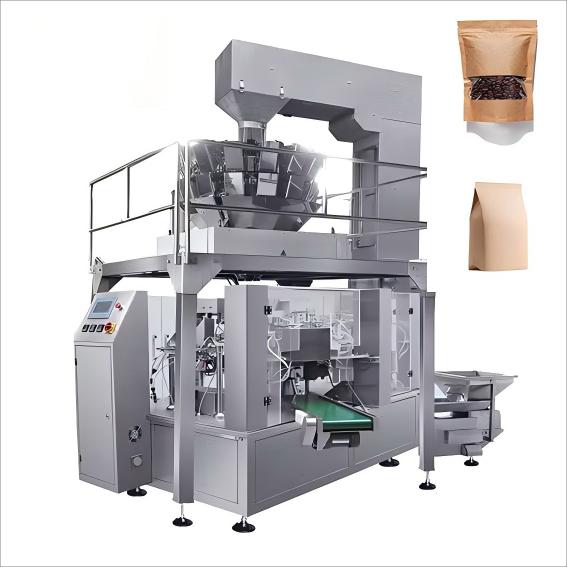
In a lot of premade pouch designs, pneumatics show up in places like:
Gripping and clamping (pouch grippers, holding jaws).
Air jets and blow-off functions (helping pouches open, clearing small debris).
Simple diverters and reject gates.
Valve control for vacuum and air assist systems.
Pneumatics shine when the motion is binary and fast. That’s the “good” version.
Servo-driven motion often appears where timing and repeatability can make or break throughput:
Indexing / synchronized movement (especially on rotary platforms).
Coordinated movement tied to fill timing and sealing windows.
Recipe-based changeovers (repeatable settings per pouch type, product, and speed).
In food packaging, that timing control matters because the machine isn’t just moving parts—it’s moving parts around messy reality: powder dust, sauce drips, product bounce, and pouch variability.
Servo can reduce inconsistency-driven defects, but it won’t fix poor pouch quality, bad filling design, or a dirty sealing area.
Let’s be honest: “motion system” gets blamed for everything because it’s easy to point at. But the defects that hurt food pouch packaging usually come from a mix of motion, filling, and hygiene control.
Leakers (seal integrity failures).
Seal contamination (powder dust or sauce on the seal area).
Inconsistent pouch opening (mis-open → spill → downtime).
Product caught in the seal (especially granules and chunky mixes).
Weight rejects (not always motion-related, but timing can amplify issues).
Servo can help stabilize the process—especially the “same move, same result” part. But if the pouch film is inconsistent or the sealing area is constantly getting contaminated, a servo motor won’t save you.
For powders: if dust lands where you need a clean seal, you’ll fight leakers no matter what motor you bought.
For liquids/sauces: anti-drip and “keep the seal area clean” are the real kings.
For granules: timing and pouch handling matter, but so does how the product drops and settles before seal.
I’m not saying “don’t buy servo.” I’m saying: buy servo for the right reasons, and design the rest of the system like you actually package food.
Pneumatics can work well for simpler food lines, but compressed air stability and leak discipline decide whether it stays cost-effective.
Pneumatics have one huge advantage: the upfront cost often looks friendly. And in some operations, that’s the correct decision.
But compressed air is also where “cheap” gets sneaky. A pneumatic-heavy machine doesn’t just require cylinders and valves—it requires a healthy air ecosystem.
Moderate speed goals.
A stable compressed air system already exists (and it’s not an afterthought).
Fewer SKUs, fewer pouch formats, fewer changeovers.
A maintenance team that’s comfortable with leak checks, valve islands, and cylinder rebuilds.
If that’s your reality, pneumatics can be totally fine. No shame in it.
Air leaks: they’ll happen, and they quietly become a utility tax.
Pressure fluctuations: inconsistent actuation can lead to mis-grips, missed openings, and stoppages.
Maintenance frequency: seals and fittings are consumables in real life, not theory.
If your plant struggles with air quality and leaks, a pneumatic-heavy system can become the gift that keeps billing.
If you change pouch sizes, products, or speeds often, servo usually pays back through faster, more repeatable changeovers.
Food producers love variety. It sells. It also punishes equipment that can’t repeat settings reliably.
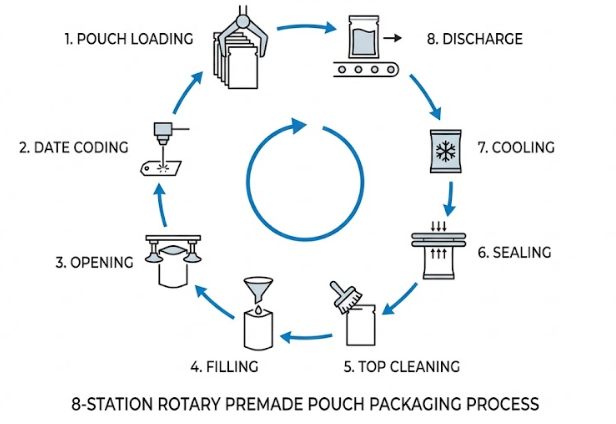
When changeovers are frequent, servo-driven adjustments and stored recipes can be a big operational advantage. Not because servo is “better,” but because repeatability protects you from human variation across shifts.
“We run multiple pouch sizes.”
“We do changeovers weekly… sometimes daily.”
“Operator A gets it stable. Operator B fights it.”
“We need repeatable settings that don’t depend on tribal knowledge.”
If yes, servo-heavy motion starts looking less like a luxury and more like a risk-control strategy.
The right choice depends on quality risk, changeover frequency, and utilities—not marketing claims.
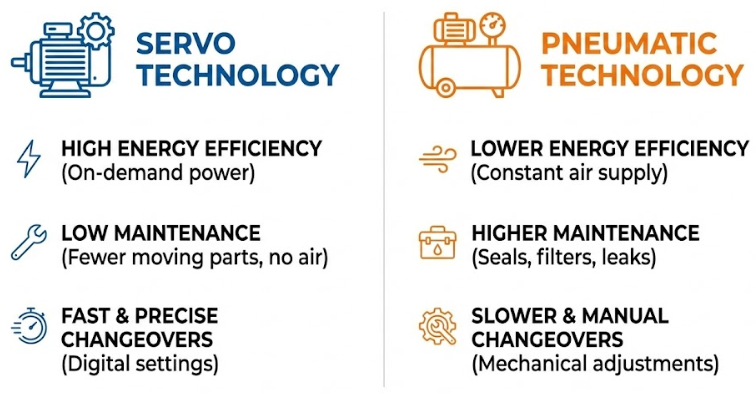
Here’s the table I wish buyers used before they request quotes:
| Factor (Food Packaging) | Servo-heavy tends to win when… | Pneumatic-heavy tends to win when… |
|---|---|---|
| Seal consistency | You need fewer leakers and tighter control | Tolerances are wider, speed is modest |
| Changeovers | Frequent SKU/pouch format changes | Rare changes, stable product mix |
| Utilities | You want less dependence on compressed air | You already run strong air infrastructure |
| Maintenance style | You want predictable routines | You’re set up for leak/cylinder/valve upkeep |
| Budget (Capex) | You can invest upfront for stability | You need the lowest initial purchase cost |
Simple? Not really. But that’s the point: it’s a business decision, not a fan club.
Hybrid designs are common because pouch handling often benefits from pneumatics while timing/indexing benefits from servo.
Here’s the thing: most real-world premade pouch machines aren’t “servo-only” or “pneumatic-only.” They’re a mix. And honestly, that’s often the best outcome.
Pouch gripping, opening assist, and basic clamping are places pneumatics can be perfectly effective. Meanwhile, coordinated motion tied to speed, timing, and repeatability can benefit from servo control.
How do you protect the seal area from powder dust or sauce drips?
Which stations are servo vs pneumatic, and what’s the reason (not the buzzword)?
What happens when air pressure dips or when a pouch mis-opens?
Can operators save and lock recipes per SKU?
How does the machine support sanitation and allergen changeovers?
If a supplier can’t answer these clearly, the “servo vs pneumatic” label isn’t the real problem.
Start by matching machine configuration to food product type—then optimize the motion system.
If you’re narrowing options, it helps to choose by application first (powder vs granule vs liquid). These pages are natural starting points:
Premade pouch machine overview:
https://foodbaggingmachine.com/premade-pouch-packing-machine.html
Powder pouch packing machine (seasonings, blends, flour-like powders):
https://foodbaggingmachine.com/product/powder-pouch-packing-machine.html
Granule packaging solutions (snacks, nuts, candy):
https://www.foodbaggingmachine.com/granule-packaging-solutions.html
Liquid packaging solutions (sauces, dressings, pastes):
https://www.foodbaggingmachine.com/liquid-packaging-solutions.html
If you want the motion discussion to stay practical, anchor it to the product. Powder and sauce will punish sloppy sealing cleanliness far faster than most people expect.
Answer these 10 questions and the servo vs pneumatic choice gets a lot less emotional.
What’s the target output and realistic OEE goal?
What pouch styles will you run (stand-up, zipper, spout, etc.)?
What’s the product behavior (dusty, sticky, oily, chunky)?
How sensitive is your seal area to contamination?
How stable is your compressed air (pressure, flow, dryness)?
Do you have an actual leak-check routine—or just good intentions?
How often are changeovers, and who performs them?
What integrations are required (checkweigher, metal detector, coder)?
What sanitation level is required (washdown, allergen changeover needs)?
What’s the acceptance test (leakers rate, mis-open rate, weight rejects)?
If you can’t answer these internally, the next best step is to ask suppliers to design around them—not just quote a machine model number.
Often yes when you need consistency and frequent changeovers, but pneumatics can be a strong choice for simpler, steady production with solid compressed air infrastructure.
They can help by improving repeatability and timing, but seal integrity also depends on pouch quality, sealing settings, and keeping the seal area clean.
Compressed air can be energy-intensive, and leaks or unstable pressure can increase utility costs and cause performance issues over time.
Many are hybrid: pneumatics for gripping/air functions, servo for precise programmable motion where timing matters.
Dust control near the sealing area—top cleaning, stable dosing, and cleanliness design are critical.
Anti-drip performance, nozzle design, and keeping the seal area clean usually drive real-world results.
Contact: LTC Bagging System
Phone: +8613337332946
E-mail: [email protected]
Add: Wenzhou, Zhejiang Province, China