The client is a fast-growing snack brand producing a diverse range of products, including chips, popcorn, granola, and dried fruits. As the product line expanded, the company faced a growing challenge: how to maintain consistent packaging across multiple SKUs without adding staff or production lines.
Even with experienced operators, manual changeovers between bag sizes and product types caused delays, inconsistent bag weights, and uneven seals. Retailers began noticing variability on shelves, and internal quality control teams spent increasing time on rework.
Multi-SKU production creates complexity that manual processes cannot reliably handle. Each snack product has unique flow properties, different bag formats, and specific sealing requirements. Operators constantly adjusted settings between SKUs, yet small variations led to inconsistent packaging, material waste, and fulfillment delays.
Adding more workers or building additional production lines was impractical due to space and labor constraints. The company needed a solution that could adapt to multiple SKUs seamlessly, maintain consistent quality, and operate within their existing footprint.
We approached the problem with a flexibility-first mindset. Instead of prioritizing maximum speed, we focused on repeatable quality across diverse SKUs.
We began by analyzing each product’s characteristics: weight, flow behavior, bag type, and sealing requirements. Then, we implemented a modular automated packaging system capable of handling multiple bag sizes and formats with minimal downtime. Operators were trained to load product “recipes,” enabling the system to automatically adjust parameters for each SKU.
Trial runs across all SKUs verified that output remained consistent under real-world conditions. This hands-on approach ensured reliable performance from day one, reinforcing operational confidence.
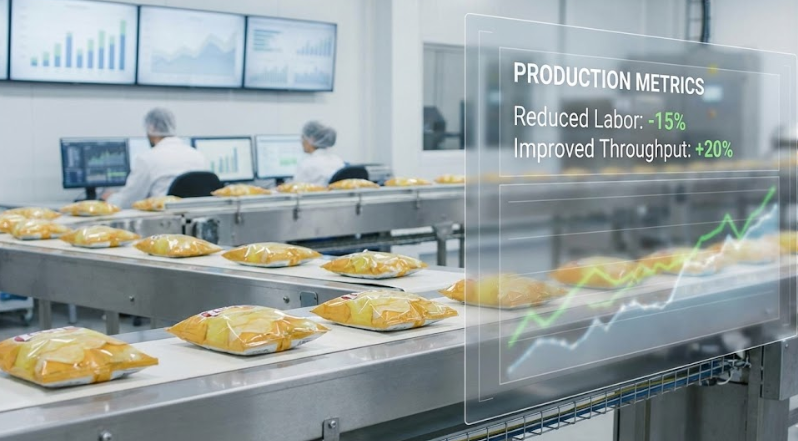
The automated system delivered measurable improvements:
Changeover time between SKUs dropped from 30–45 minutes to under 10 minutes
Bag weight deviations stayed within ±2 grams for all products
Seal consistency improved, reducing rejected bags by 40%
Production space remained unchanged; no additional lines were required
These results illustrate that automation can increase operational flexibility while maintaining high-quality standards, even in multi-SKU snack production.
Flexible automation transformed both operations and brand perception.
Retailers experienced consistent product presentation, reducing complaints and improving trust. Internal teams spent less time correcting packaging errors, allowing them to focus on preventive checks and operational optimization.
For management, the line’s predictability made planning for new product launches easier, enabling the brand to expand its portfolio confidently without disrupting existing production.
Automation proved to be not just a throughput solution, but a strategic enabler for brand consistency and operational reliability.
This approach is best for snack brands that:
Offer multiple SKUs with different weights and bag formats
Face frequent changeovers or quality inconsistencies
Want to scale product variety without expanding space or staff
Even smaller operations can benefit from semi-automatic, modular systems, which provide flexibility for future growth.
Q: Can a single automated line handle multiple SKUs reliably?
Yes. Modern modular snack packaging systems store product recipes and automatically adjust weight, speed, and sealing parameters for each SKU, ensuring consistent results across batches.
Q: Is this solution suitable for small or mid-sized snack brands?
Absolutely. Flexible automation can be scaled to match production needs, improving packaging consistency while minimizing manual intervention.
Q: How quickly are improvements seen?
Most clients notice better bag weight control, reduced seal failures, and faster changeovers within weeks of system implementation.
For snack brands managing multiple SKUs, flexibility and consistency are critical. Automation not only reduces changeover time but also protects brand reputation by delivering uniform packaging across all products. Investing in modular, recipe-driven systems ensures your operations can grow with your product portfolio, without sacrificing quality or efficiency.
Contact: LTC Bagging System
Phone: +8613337332946
E-mail: [email protected]
Add: Wenzhou, Zhejiang Province, China