
Sustainable films can run well on VFFS and HFFS—but only if you match the material structure to your product’s barrier needs and your machine’s sealing “personality” (seal window, jaw style, speed targets).
Right now, the most consistently workable path for many food brands is recyclable mono-material PE/PP (often with barrier upgrades), while compostables remain more scenario-specific because of sealing sensitivity and performance trade-offs.
VFFS/HFFS packaging film isn’t just “a roll of plastic”—it’s a functional component that directly affects seal integrity, line uptime, shelf life, and scrap.
At the same time, food companies are under real pressure to reduce packaging impact, and “sustainable film” has become a purchasing requirement rather than a marketing bonus.
This article focuses on what’s actually running today: material options that work, what usually breaks on the packaging line, and how to choose a film strategy that your VFFS/HFFS equipment can execute.
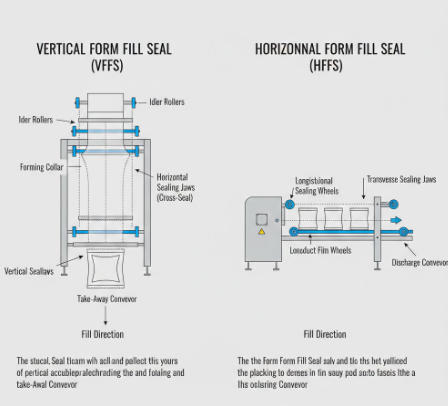
VFFS (Vertical Form Fill Seal) forms a bag from rollstock film in a vertical direction, then fills and seals—gravity often helps product dosing, especially for many dry foods and snacks.
HFFS (Horizontal Form Fill Seal) runs the web horizontally, typically forming packs like flow wraps or horizontal pouches where the forming and sealing geometry differs from VFFS.
Rollstock matters in both systems, but the film’s path, tension behavior, and sealing contact time can be very different—which is why a “sustainable film” that runs nicely on one machine can struggle on another.
According to industry research, demand for easy-to-recycle mono-material flexible packaging film is rapidly increasing as brands and value chains pursue circular-economy targets. Smithers forecasts that consumption of mono-material plastic packaging film will grow steadily through 2023–2028, driven in part by the difficulty of recycling conventional multilayer composites compared with fully recyclable mono-material films.
In procurement conversations, “sustainable film” typically falls into three practical buckets: recyclable mono-materials (Mono-PE / Mono-PP), PCR (post-consumer recycled) content structures, and compostable/bio-based films.
These categories are not equal in machine compatibility: recyclable mono-material films are often closer to conventional films in running behavior, while compostables frequently have narrower heat-seal windows and tighter process tolerance.
Here’s the mindset shift that helps: sustainability is not a single score—it’s a set of trade-offs across recyclability/compostability infrastructure, barrier performance, sealing reliability, and total line efficiency.
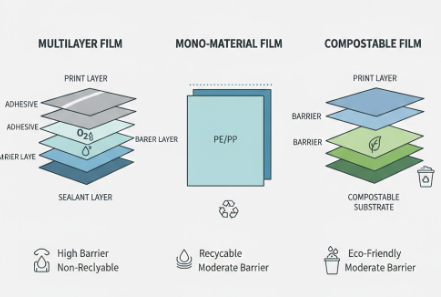
Below are the most common structures you’ll see when discussing sustainable rollstock for VFFS/HFFS, plus what they usually mean for performance on the line.
| Structure | Typical materials | Strengths | Common limitations |
|---|---|---|---|
| Multilayer co-extrusion / foil laminate | PET/AL/PE (and similar) | High barrier performance (often chosen for shelf-life protection) | Difficult to recycle in many streams |
| Mono-material recyclable | Mono-PE or Mono-PP | Easier to recycle, often compatible with many machines | Barrier can be lower unless enhanced with coatings or special layers |
| Compostable / bio-based | PLA / PHA / Cellulose | Can be industrially compostable (depending on certification/region) | Narrow sealing window; may require machine tuning or modifications |
A recent packaging industry analysis highlights that compostable films tend to cost 20–50% more than recyclable alternatives and often operate at significantly lower speeds (e.g., 25–60 bags per minute) compared to high-speed recyclable films. Additionally, regulatory frameworks such as the EU’s Packaging and Packaging Waste Regulation (PPWR) target 100% recyclable packaging by 2030, directly disqualifying many multilayer laminates and favoring mono-material structures.
If you’re trying to run sustainable films at commercial speeds, the question isn’t “Will it seal?” but “Will it seal consistently across temperature drift, dust, product contamination, and speed changes?”
Three technical realities tend to decide success:
Heat-seal window and seal strength consistency: compostables often punish small variations, while recyclable mono-material films are usually more forgiving but still need correct sealing parameters.
Line stability at speed (scrap and downtime): narrow sealing windows can translate into more rejects, more film waste, and the “mystery leaks” that only show up after case packing.
Machine-side adaptations: depending on film behavior, teams may explore jaw material changes, coating options, or process control improvements to stabilize sealing.
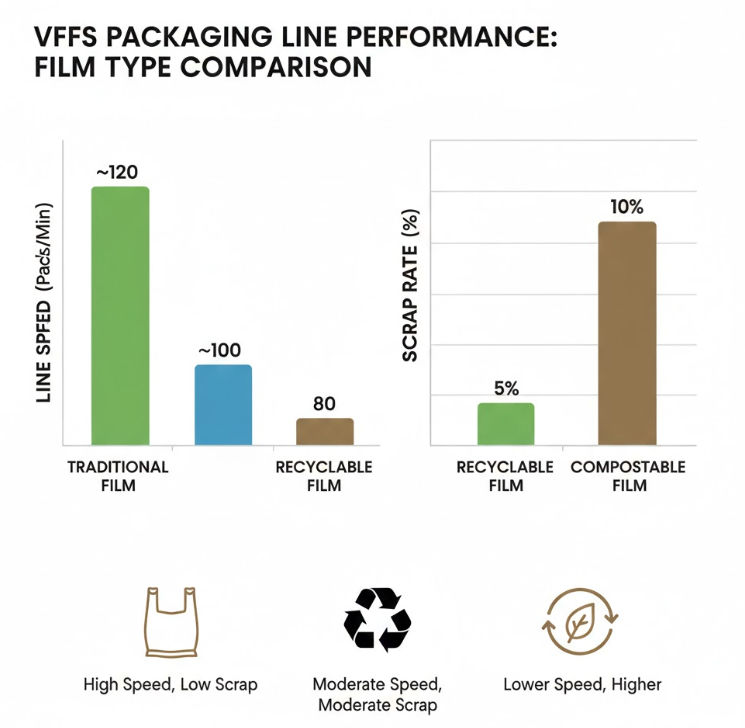
In practice, plants often report single-digit percentage speed reductions when switching to recyclable mono-material films, while compostable films may require more substantial derating to maintain seal integrity.
Plants commonly evaluate sustainable film trials on two metrics that matter more than any brochure claim: achieved line speed and scrap rate (especially seal-related scrap).
In many operations, recyclable films tend to have a smaller efficiency penalty than compostable alternatives, which may require slower speeds or tighter control to stay inside the seal window.
If you’re choosing “the best sustainable film,” start by asking one uncomfortable question: what’s the real job of the package—barrier protection, machinability, marketing optics, or end-of-life outcomes?
From there, the most practical strategy is to select by product barrier demand and distribution reality, not by material trend alone.
High barrier needs (frozen, vacuum, MAP): prioritize recyclable solutions that can deliver barrier performance reliably, because shelf-life failure is rarely an acceptable sustainability trade.
Medium barrier (snacks, dry foods): mono-PP/PE structures are often the “workhorse” option—good machinability, better recyclability story, and manageable cost/availability.
Low barrier / fast turnover (some fresh produce): lightweighting and right-sizing can be highly effective; compostables may fit specific channels where composting infrastructure and customer behavior support it.
A practical example: if you run a VFFS snack line today and your biggest pain is seal defects at speed, a recyclable mono-material film with proven sealing stability is usually a smarter first step than jumping straight to compostables.
If you’re aligning film choices with automation goals (scrap reduction, traceability, and consistent seals), these guides help connect sustainability decisions to day-to-day production realities:
Smart packaging & traceability
https://foodbaggingmachine.com/new/smart-packaging-enhancing-food-safety-and-traceability.html
Reduce packaging waste through automation
https://foodbaggingmachine.com/new/How-to-Reduce-Packaging-Waste-Through-Automation.html
If you’ve been comparing suppliers like honorpack.com or all-fill.com, one differentiator we emphasize at FoodBaggingMachine.com is “film + machine as one system”—not just equipment selection, but film-compatibility thinking that protects OEE (speed, scrap, seal quality) during sustainability transitions.
VFFS film is used on vertical form-fill-seal lines, where the package is formed vertically and product dosing often relies on gravity. HFFS film is used on horizontal form-fill-seal machines, typically for flow wraps or horizontal pouches, with different forming geometry and sealing contact time.
Yes—but compatibility depends heavily on film structure. Recyclable mono-material films (Mono-PE or Mono-PP) usually run with minimal machine modification. Compostable films, by contrast, often have narrower heat-seal windows and require tighter temperature and process control to run consistently.
The most common options include recyclable mono-material PE/PP structures, PCR (post-consumer recycled) content films, and compostable or bio-based films such as PLA or PHA. Each option involves trade-offs between recyclability, barrier performance, sealing stability, and line efficiency.
Sustainable films can influence sealing speed, scrap rate, and downtime. In most commercial operations, recyclable mono-material films create less disruption to line efficiency, while compostable films may require reduced speeds or tighter control to maintain seal integrity.
Contact: LTC Bagging System
Phone: +8613337332946
E-mail: [email protected]
Add: Wenzhou, Zhejiang Province, China