In today's manufacturing landscape, packaging waste is no longer just an environmental concern—it is a critical financial and regulatory liability. With the rise of Extended Producer Responsibility (EPR) laws and increasing raw material costs, food manufacturers are under immense pressure to optimize their production lines. The solution lies in the convergence of automatic packaging and smart packaging technologies.
This guide explores how transitioning from manual to automated processes can significantly reduce packaging waste, minimize product giveaway, and ensure compliance. We will examine proven strategies, from right-sizing boxes to integrating intelligent sensors, backed by industry leaders like Packsize and Ranpak who have demonstrated that automation can drastically cut material usage.
Why Packaging Waste Matters (Financial & Regulatory)
Automatic Packaging: Mechanics of Waste Reduction
Smart Packaging: Sensors & Traceability
Top 6 Automation Strategies
Real-world Case Studies
FoodBaggingMachine.com Solutions
Implementation Checklist
ROI & Costs
FAQ
Before investing in automation, it is essential to understand the "cost of inaction." Packaging waste impacts the bottom line through three primary channels:
Wasted film, oversized boxes, and excessive void fill directly inflate the cost of goods sold (COGS). Furthermore, inefficient packaging leads to "shipping air," driving up logistics costs significantly.
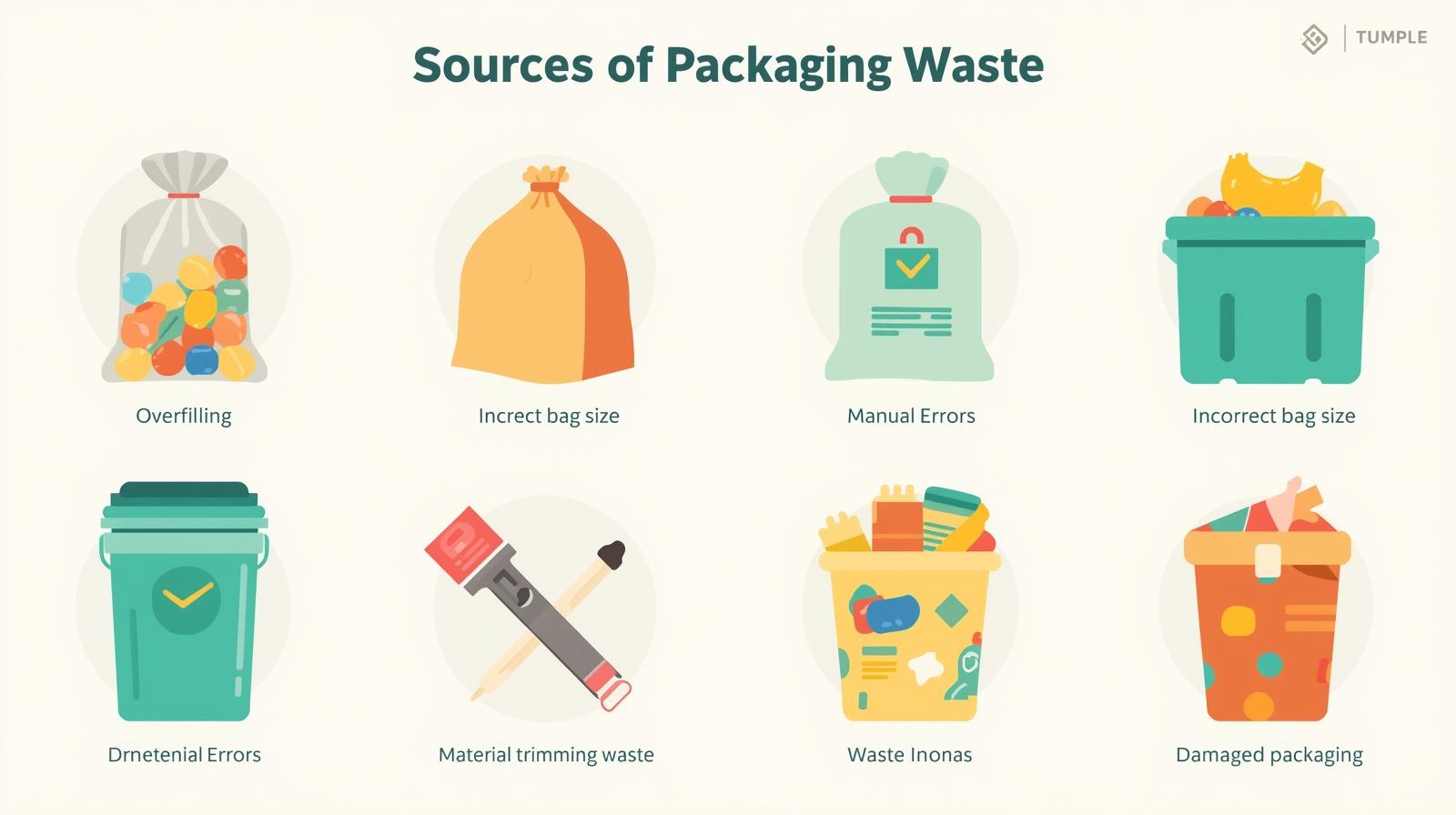
Manual errors often result in sealing defects, leading to product spoilage or returns. In the food industry, shelf-life reduction due to poor packaging integrity is a major source of revenue loss.
Governments globally are enforcing stricter recycling mandates. Initiatives like the M&S and Polytag collaboration demonstrate how tracking and recycling viability are becoming prerequisites for market access.
Key Insight: The total cost of packaging waste includes materials, transport, returns, and disposal fees—often representing 5-15% of total production costs.
Automatic packaging refers to the use of robotic or mechanical systems to manage packing tasks without human intervention. This includes machinery such as:
Robotic case packers
On-demand box makers
As seen in turnkey solutions provided by companies like Plan IT and Massman, automation creates a consistent, error-free workflow that manual labor cannot match.
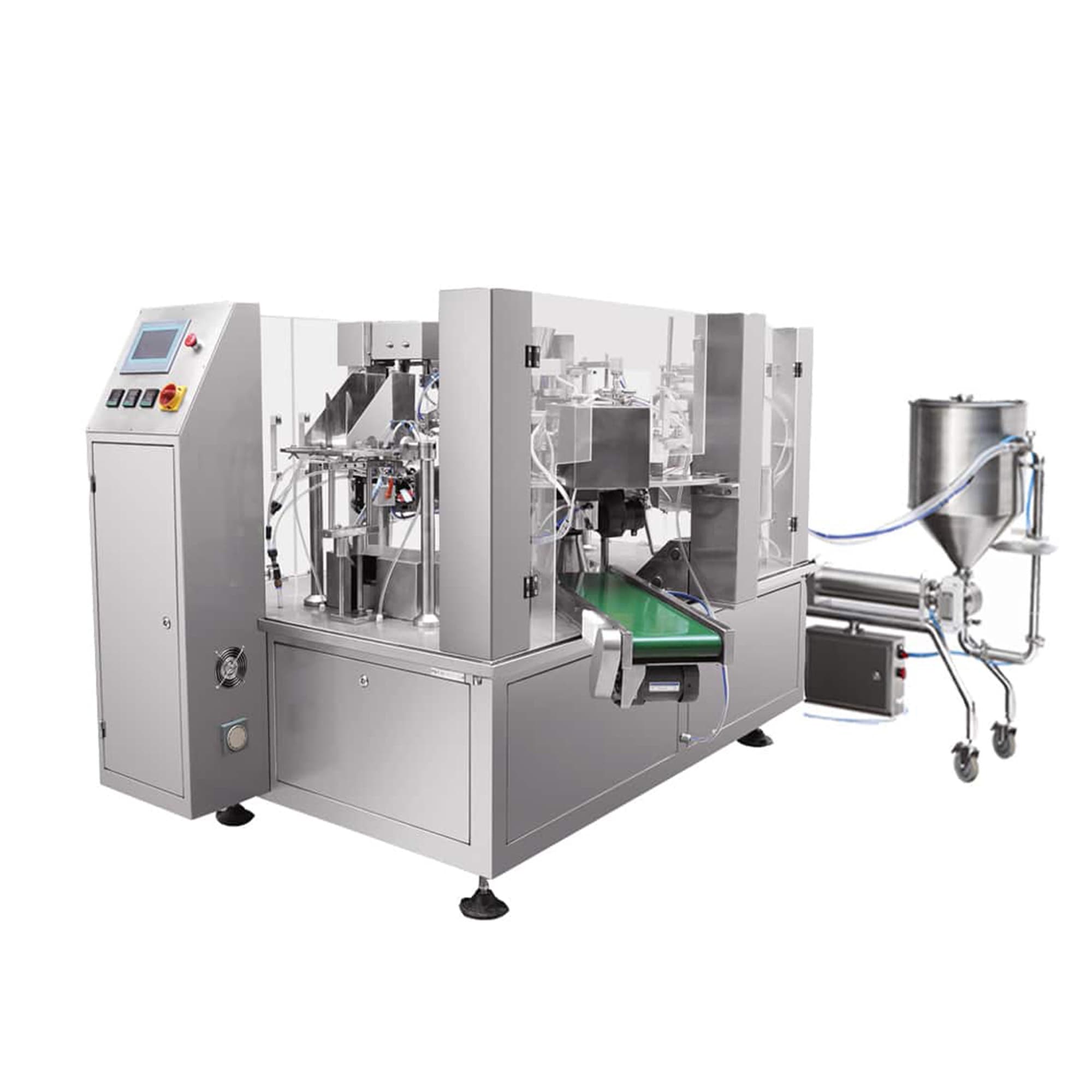
Automation targets waste at the source through precision:
Right-Sized PackagingSystems like Packsize create boxes on-demand tailored to the product's exact dimensions. This eliminates the need for standard-sized boxes that are too large, significantly reducing void fill requirements and lowering transport volume.
Precision Filling (Reducing Giveaway)In food packaging, "giveaway" (overfilling packs to ensure legal weight) is a massive hidden cost. Automated multi-head weighers ensure exact dosing, minimizing product loss by up to 2-5% in high-volume operations.
Automated InspectionVision systems detect defects immediately. By rejecting a single faulty pack before it is palletized, manufacturers prevent entire batches from being returned or discarded.
Smart packaging involves systems that monitor the condition of packaged food or interact with the environment. It is categorized into:
Active packaging: Extends shelf life through modified atmosphere or moisture control
Intelligent packaging: Communicates data through sensors, RFID, or NFC tags
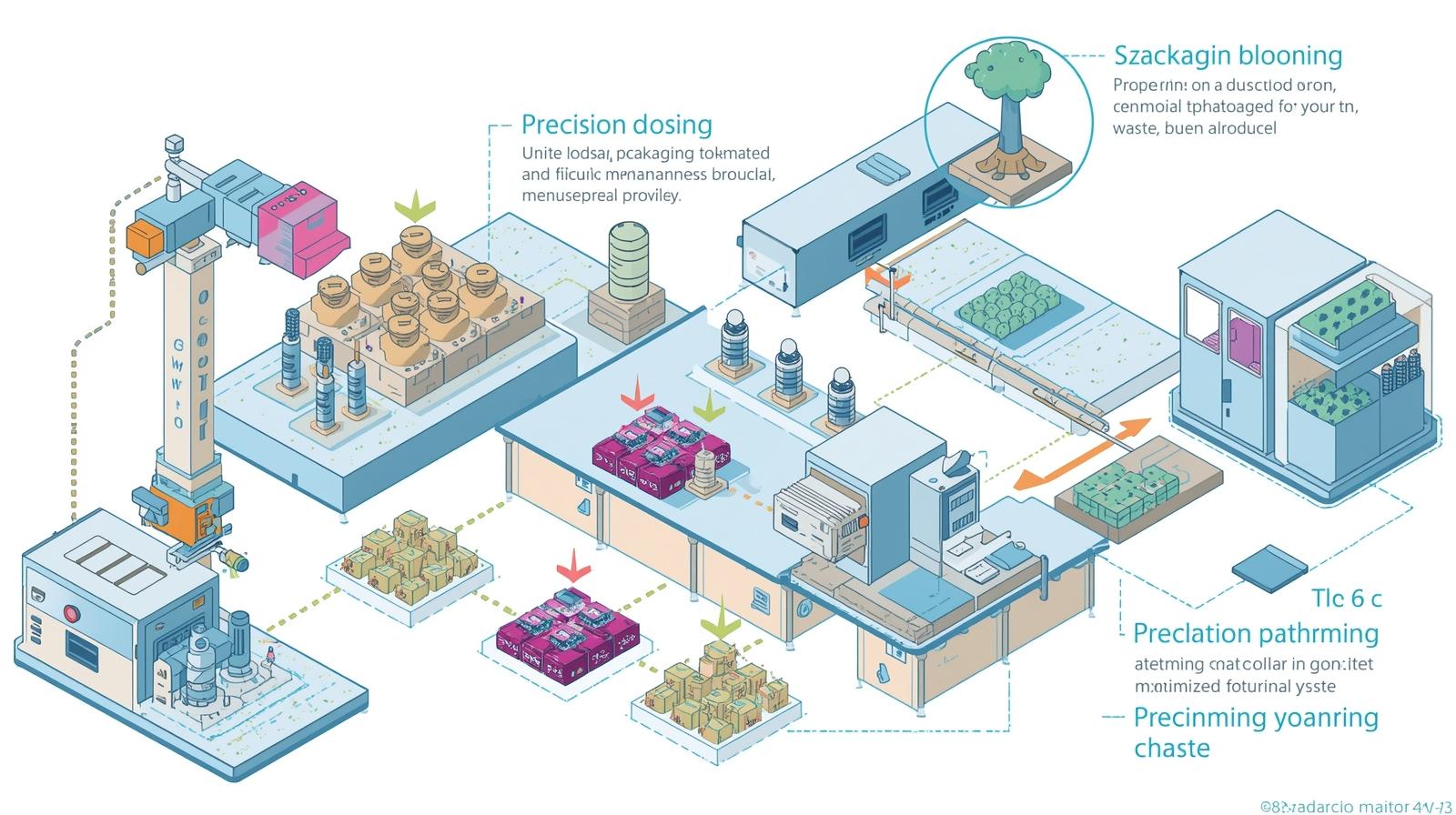
Freshness MonitoringTemperature and gas sensors can monitor the cold chain throughout distribution. If a threshold is breached, the system alerts managers, allowing them to prioritize selling that batch rather than discarding it due to assumed spoilage.
Traceability & RecyclingTechnologies like RFID, NFC, and digital watermarks (Polytag) improve sorting efficiency at recycling facilities, ensuring materials are actually recycled rather than landfilled due to contamination.
Inventory OptimizationSmart barcodes provide real-time data on stock levels, helping prevent overproduction and expiration—a critical concern in the food industry where 30-40% of waste occurs at the retail level.
To achieve measurable sustainability goals, manufacturers should implement these six strategies:
Action: Install machines that cut cardboard to fit the product dimensions exactly.
KPI: Reduction in cardboard use and void fill volume (typically 20-40% savings).
Action: Use high-precision auger or multi-head weighers to eliminate overfilling.
Benefit: Drastically reduces product giveaway, especially valuable for expensive ingredients like spices, coffee, or protein powders.
Action: Deploy X-ray or vision systems to catch seal breaches early in the production line.
KPI: Lower customer return rates due to leakage (target: <0.1% defect rate).
Action: Ensure your automation equipment can run paper-based or mono-material films (as championed by Ranpak) without jamming.
Benefit: Future-proofs your line for EPR compliance.
Action: Incorporate modified atmosphere packaging (MAP) with integrated sensors.
Benefit: Extends product life by 30-50%, reducing retail waste significantly.
Action: Connect packaging machine data to ERP systems to match production exactly to demand.
Benefit: Prevents surplus production waste (a major issue in seasonal food products).
By implementing on-demand box making, companies have reported 20-30% reductions in corrugated material usage and 15-25% savings in shipping volumes, proving that "right-sizing" is a premier waste reduction strategy.
Ranpak demonstrates how integrating automated paper cushioning can replace plastic bubble wrap, simultaneously increasing packing speed by 25% and meeting sustainability goals.
A European success story highlighted by the Digital Innovation Hubs showed that replacing manual packing with automation improved efficiency by 35% while reducing material waste by over 10%.
At LTC PACK, we specialize in automated packaging solutions rooted in engineering precision. As a leading manufacturer based in Asia, we provide end-to-end bagging systems designed to minimize both material and product loss.
Precision Powder PackingOur Powder Pouch Packing Machines are engineered with advanced auger fillers that strictly control dosage. This minimizes dust generation and product giveaway, ensuring every gram of your product is sold, not wasted.
Smart Packaging IntegrationWe support the integration of coding and marking systems essential for traceability. Read more about our approach in our article: Smart Packaging: Enhancing Food Safety and Traceability.
Strategic PlanningMoving to automation requires a clear roadmap. We offer a comprehensive White Paper that details the technical specifications and ROI calculations for upgrading your line.
We recommend starting with a pilot program. Test your specific film materials on our machines to verify seal integrity and waste metrics before a full-scale plant rollout. This approach reduces risk and provides concrete data for decision-making.
Ready to automate? Follow this 10-step checklist to ensure a smooth transition:
Audit Current Waste — Establish a baseline for material waste and product giveaway
Define KPIs — Set targets (e.g., "Reduce film waste by 15%")
Material Selection — Choose recyclable materials compatible with automation
Equipment Selection — Prioritize machines with high accuracy (check our product catalog)
Pilot Test — Run a small batch to test seal quality and speed
Staff Training — Train operators on machine parameters to prevent error-induced waste
Measure OEE — Monitor Overall Equipment Effectiveness during the pilot
Scale-Up — Roll out to main production lines
Data Integration — Connect machines to your ERP for real-time monitoring
Continuous Review — Re-evaluate waste metrics quarterly
Download this Checklist as a PDF via our White Paper page
Automation is an investment, but the ROI is measurable and typically realized within 12-24 months.
CAPEX (Machinery purchase)
Installation and integration costs
Maintenance and spare parts
Training expenses
Reduced labor costs (20-40% reduction in packing line staff)
Lower material consumption via right-sizing (15-30% savings)
Reduced shipping costs (10-25% savings through volume reduction)
Lower waste disposal fees
ROI = (Annual Savings - Annual Costs) / Initial Investment × 100%

Where:
Annual Savings = Labor + Material + Shipping + Disposal Savings
Annual Costs = Maintenance + Energy + Consumables
Initial Investment = Equipment + Installation + Training
A: ROI typically varies based on production volume and material savings, but many manufacturers see a break-even point within 12 to 24 months. High-volume operations can achieve payback in as little as 8-10 months.
A: Yes. By using technologies like right-sizing (creating smaller boxes) and precision weighing, you can significantly reduce waste using your existing materials. However, combining automation with recyclable materials maximizes both environmental and cost benefits.
A: While initial setup costs for sensors or RFID can be high, the long-term savings from reduced returns, extended shelf life, and inventory control often outweigh the upfront investment. Start with basic traceability systems and scale up as ROI is proven.
A: Automatic packaging focuses on mechanical automation (filling, sealing, packing), while smart packaging adds intelligence through sensors and data communication. The best approach combines both for maximum waste reduction.
A: Start by calculating your current waste metrics and production volume. For operations under 50 units/minute, semi-automatic solutions may suffice. For higher volumes, fully automated lines with integrated inspection deliver the best ROI.
Reducing packaging waste is no longer optional—it is a competitive necessity. By combining automatic packaging precision with smart packaging data, manufacturers can achieve a dual victory: sustainability compliance and significant cost reduction.
The path forward involves:
Starting with a thorough waste audit
Selecting the right automation technology for your production scale
Implementing in phases with measurable KPIs
Continuously optimizing based on data
Start your journey toward a zero-waste production line today.
Download our Comprehensive White Paper to get the full technical guide, or Contact Us for a personalized assessment of your facility.
Contact: LTC Bagging System
Phone: +8613337332946
E-mail: [email protected]
Add: Wenzhou, Zhejiang Province, China