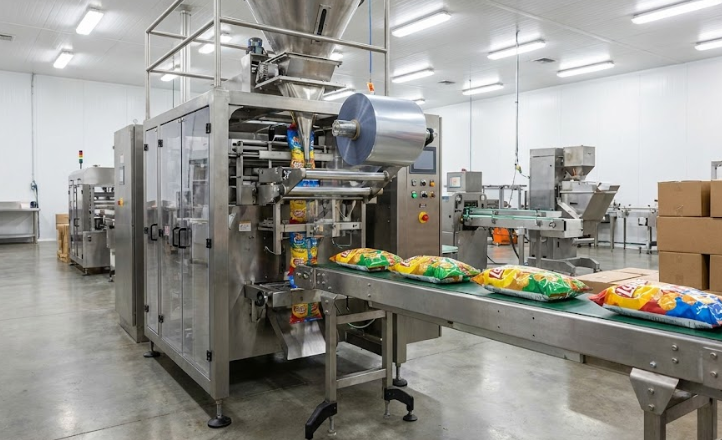
The client is a growing snack food manufacturer producing bagged snack products for regional distribution.
Their product range includes multiple SKUs with similar packaging formats, supplied mainly to retail and private-label customers.
As order volume increased, upstream processing capacity remained sufficient. However, packaging began to expose a different kind of limitation—labor dependency.
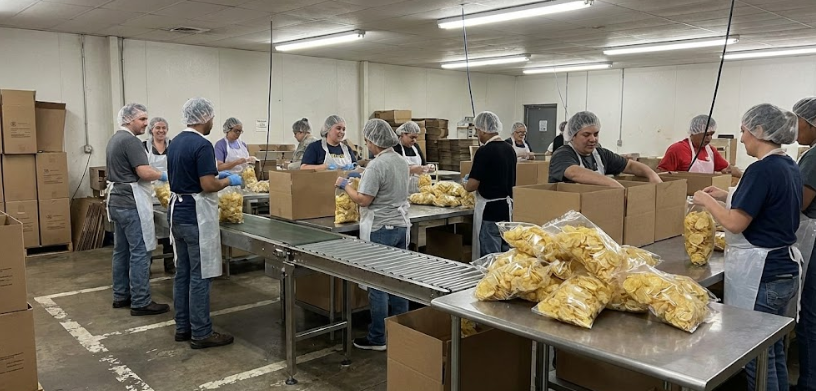
Unlike equipment-related bottlenecks, the client’s main issue was people-related.
Their packaging line relied on manual weighing and bagging, which led to:
High dependence on experienced operators
Inconsistent output between shifts
Increasing difficulty in recruiting and retaining packaging workers
During peak seasons, packaging output became unpredictable, directly affecting delivery schedules.
Manager Jason reported that packaging output varied significantly depending on shift staffing, making production planning increasingly unreliable.
The initial idea was straightforward: hire more workers.
In practice, this approach created new risks instead of solving the problem. Training time, turnover, and performance variability meant that adding staff did not guarantee stable output. In some cases, more people on the line actually reduced efficiency.
At this stage, labor availability—not demand—had become the limiting factor.
Our role was to help the client reduce operational dependence on manual labor, without forcing a complete overhaul of their existing production layout.
Rather than pushing for maximum speed, the focus was on:
Reducing manual intervention
Standardizing packaging performance
Making output less sensitive to staffing changes
Based on the product characteristics and bag format, we proposed an automated weighing and vertical packaging solution designed for stable, continuous operation.
Of course, based on similar snack packaging projects, we prioritized system stability and operator simplicity over maximum speed.
As with most transitions from manual to automated packaging, the setup phase required careful adjustment.
During trial runs, weighing accuracy was optimized to match product flow behavior, and sealing parameters were fine-tuned to ensure consistent bag quality across different shifts.
Once parameters were stabilized, operators were trained to manage the system with minimal manual input.
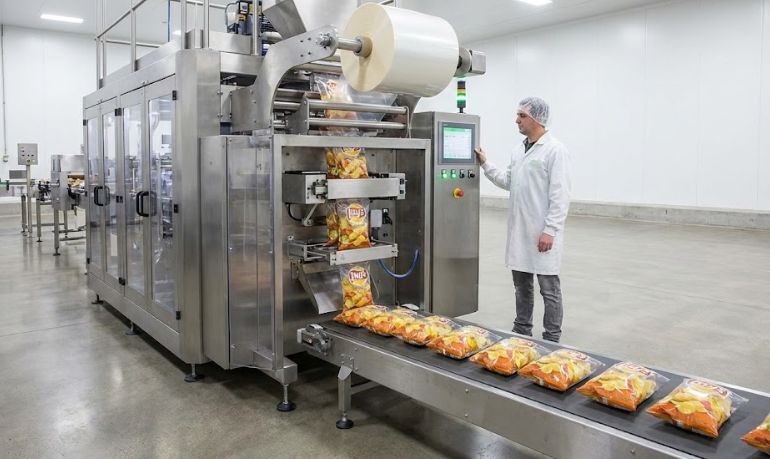
Before automation, packaging output typically ranged between 20–30 bags per minute, highly dependent on operator experience and shift conditions.
After implementing the automated packaging system, stable output increased to approximately 45–55 bags per minute, with significantly reduced variation between shifts.
Most importantly, this improvement was achieved with fewer operators on the packaging line, reducing daily labor pressure while maintaining consistent performance.
This project follows a pattern we frequently see in small to mid-sized snack operations, where labor—not equipment—is the primary constraint to growth.
With labor no longer acting as a critical constraint, the client gained better control over daily production planning.
Packaging output became predictable, training requirements were reduced, and management no longer had to rely on specific individuals to maintain throughput.
This shift allowed the company to focus on order fulfillment and growth, rather than short-term staffing challenges.
This type of packaging automation is particularly suitable for food manufacturers who:
Rely heavily on manual weighing and bagging
Experience output fluctuations due to staffing changes
Face ongoing labor recruitment or retention challenges
Want more predictable packaging performance without expanding facilities
For very small-scale or early-stage operations, semi-automatic solutions may still be a better fit.
Actual performance depends on product characteristics, packaging format, and operating conditions.
Q: Will automation eliminate the need for operators entirely?
No. Automation reduces manual workload and dependency, but operators are still required for monitoring, replenishment, and quality checks.
Q: Is this type of system difficult to operate?
The system is designed for daily production use. After basic training, most operators can manage it without specialized technical skills.
Q: Can the system handle different snack products?
Yes. Within a compatible product range, parameters can be adjusted to accommodate different SKUs and bag sizes.
If labor availability is limiting your packaging performance, automation does not have to be a disruptive leap. In many cases, the right system can stabilize output, reduce reliance on manual work, and support growth without increasing operational complexity.
If you are facing similar challenges, we are happy to review your current packaging process and share practical recommendations based on real project experience.
Contact: LTC Bagging System
Phone: +8613337332946
E-mail: [email protected]
Add: Wenzhou, Zhejiang Province, China